Guitar tablature — usually called “tab” — is the most popular way guitarists write and share music. It’s faster to learn than sheet music, requires no music theory knowledge to get started, and gets you playing real songs in minutes rather than months. This guide takes you from zero to confidently reading any guitar tab you find, including the visual notation used in Guitar Scribble’s editor.
Guitar tablature is a visual system for writing guitar music that shows you exactly where to put your fingers on the fretboard, rather than which pitches to play. Instead of notes on a staff, you see a diagram of the guitar neck with numbers showing which frets to press.
Tablature has been used by guitarists for decades. Today millions of tabs exist online for virtually every song ever recorded. Learning to read tab is one of the most practical skills a guitarist can develop.
A guitar tab is written on six horizontal lines, one for each string. The most important thing to understand: the bottom line is the lowest-pitched string (the thick low E), and the top line is the highest-pitched string (the thin high e). This mirrors how the strings look when you glance down at your guitar while playing.
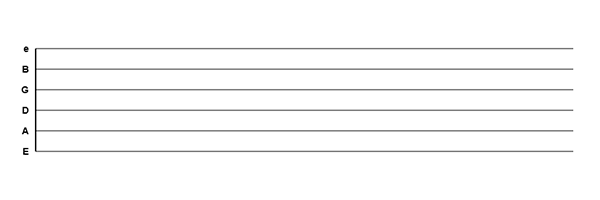
| Tab Line | String | Note (Standard Tuning) | Description |
|---|---|---|---|
| Top (e) | 1st string | E4 | Thinnest, highest pitch |
| 2nd (B) | 2nd string | B3 | |
| 3rd (G) | 3rd string | G3 | |
| 4th (D) | 4th string | D3 | |
| 5th (A) | 5th string | A2 | |
| Bottom (E) | 6th string | E2 | Thickest, lowest pitch |
Numbers on the lines tell you which fret to press. Fret 1 is closest to the headstock; numbers increase as you move toward the body. Press the string down just behind the fret wire and pick or pluck the string.
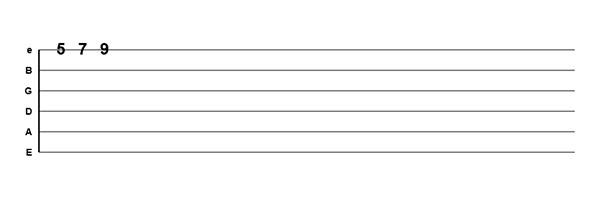
A 0 means play that string open — without pressing any fret. Open strings appear constantly in tabs at all levels.
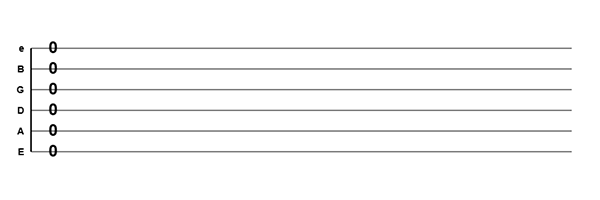
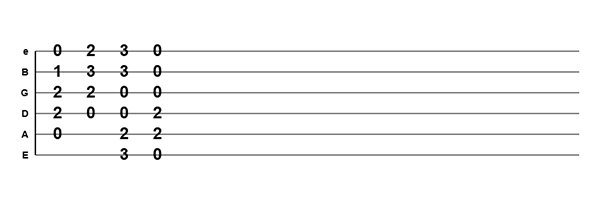
Tab is read left to right, like text. Notes at the same horizontal position are played simultaneously. Notes appearing in sequence are played one after the other.
Basic fret numbers carry you through simple tabs. Once you encounter more expressive music you’ll see technique symbols. Guitar Scribble renders these as proper visual graphics rather than plain text characters — here is exactly what each one looks like and what it means.
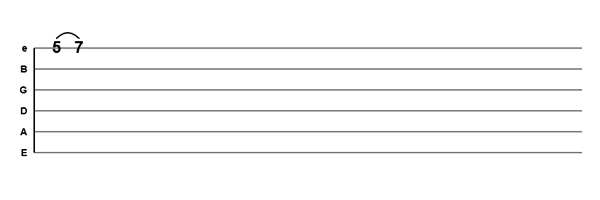
A hammer-on means you pick the first note, then bring a second finger sharply down onto a higher fret without picking again. In Guitar Scribble, a hammer-on is shown as a curved arc above the string connecting the two notes.
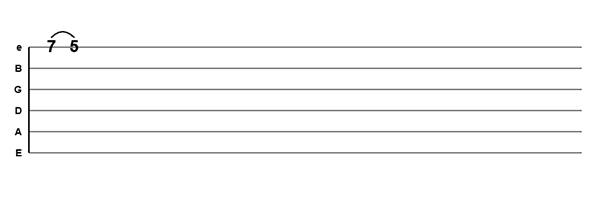
A pull-off is the reverse of a hammer-on. You pick the higher note, then flick the finger off the string to sound the lower note beneath.
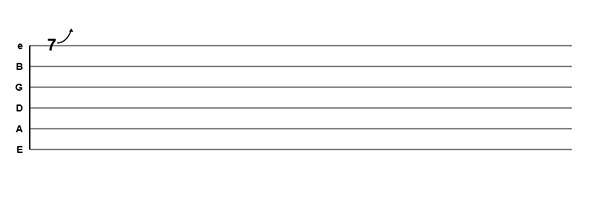
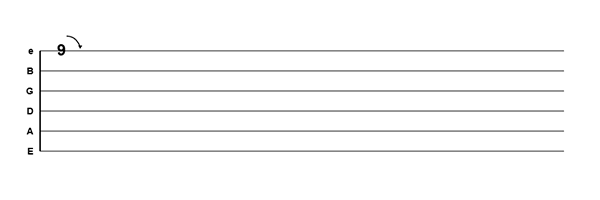
Bending means pushing the string sideways across the fretboard after picking, raising the pitch. Guitar Scribble renders bends as a curved arrow pointing upward with the bend amount shown in purple: ¼ (quarter step), ½ (half step), or 1 (full step — a whole tone up). A pre-bend uses a downward arrow, meaning the string is already bent before you pick it.
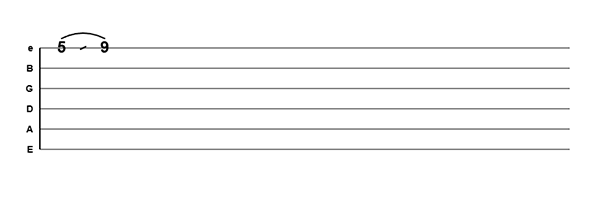
A slide means you pick the first note, maintain pressure, and glide your finger along the string so the pitch transitions smoothly. In Guitar Scribble, slides are shown as a curved arc with a diagonal slash inside to show direction: angled up for slide up, down for slide down.
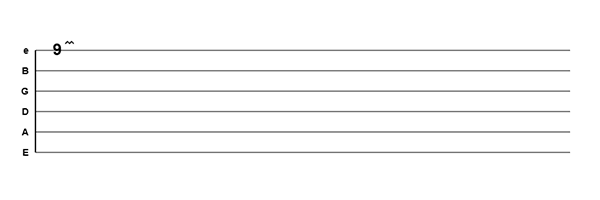
Vibrato is the technique of rapidly bending and releasing a held note slightly, creating the singing wavering quality heard from great blues and rock soloists. In Guitar Scribble, vibrato appears as a small wavy line above the note.
| Visual in Guitar Scribble | Technique | What to Do |
|---|---|---|
| Arc connecting two notes | Hammer-on | Pick first note, hammer a finger onto the higher fret without picking again |
| Arc connecting two notes | Pull-off | Pick the higher note, pull finger off to sound the lower fretted note |
| Upward arrow + (optionally) purple number | Bend | Pick note, push string sideways to raise pitch. ¼, ½, or 1 = amount |
| Downward arrow + (optionally) purple number | Pre-bend | String already bent before picking; release drops pitch back down |
| Arc + diagonal slash | Slide | Glide finger along string from one note to another, maintaining pressure |
| Wavy line above | Vibrato | Rapidly oscillate string pitch while sustaining the note |
| <12> | Harmonic | Touch string lightly over fret wire (don’t press) for a bell-like tone |
| x | Dead note | Muted, percussive hit with no clear pitch |
| PM—— | Palm mute | Rest picking hand edge on strings near bridge for chunky, dampened tone |
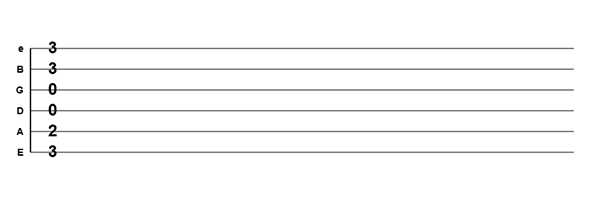
When numbers are stacked vertically, they represent a chord — all those strings played simultaneously by strumming. Chord names are often written above the staff for reference.
Start with a simple melody, not chords. Single-note lines are much easier to decode while you’re getting comfortable with the format. Scale patterns, simple riffs, and melodies are ideal starting material.
Go slowly — much more slowly than feels necessary. Play through the tab at a crawl, sounding out each note individually. Accuracy comes long before speed. Every great guitarist spent time playing frustratingly slowly before they played fast.
Listen to the song while reading. Match what you hear to what you see on the tab. This builds the critical skill of connecting sounds to fretboard positions — something reading alone can’t teach.
Use a metronome. Once you know the notes, practice with a metronome at a slow tempo and gradually increase. Our free online metronome is built exactly for this kind of practice.
Break long tabs into small sections. Learn 4 bars, get them solid, then add the next 4. Don’t attempt the whole tab from start to finish until each section is clean on its own.
New to guitar? Make sure you have the right gear before diving in. See our recommended gear for beginners — picks, strings, a tuner, and the essentials to get started right.
Standard notation conveys pitch, duration, dynamics, and more — it’s the universal language of music. Tab trades rhythmic precision for immediate, guitar-specific fretboard information. You don’t need years of theory training to read a tab; you can go from looking at one to playing within seconds.
The main limitation is rhythm: tab alone doesn’t tell you how long to hold each note or exactly when to play it. You need to already know how the song sounds, or reference a tab that includes rhythm notation above the staff.
Many serious guitarists learn both systems — tab for quick practical playing, notation for deeper musical understanding. For most guitarists playing popular music, rock, blues, or country, tab will be the primary system used throughout their entire career. That’s perfectly fine.