House of the Rising Sun is one of the oldest and most enduring folk songs in the American tradition, with roots tracing back to English broadside ballads of the seventeenth and eighteenth centuries. The song tells the story of a life gone wrong in New Orleans, and its narrator warns others to avoid the same fate. While many artists have recorded versions over the decades — including Lead Belly, Woody Guthrie, and Bob Dylan — it was The Animals' 1964 electric arrangement that turned the song into an international hit and a defining moment in the British Invasion. That recording, driven by Alan Price's iconic organ riff and Eric Burdon's raw vocal delivery, reached number one on charts around the world and helped bridge the gap between folk music and rock. The song's arpeggiated chord progression has since become a rite of passage for guitarists, making it one of the most widely learned pieces in guitar education. As a traditional folk song, its melody and lyrics are in the public domain. Prefer to strum and sing it? See the House of the Rising Sun chords and lyrics sheet.
Writing your own music? Start a blank tab from scratch, free →
👁 Preview printable PDF/PNGTap any chord for its diagram, other voicings, and the notes inside it, from our chord library.
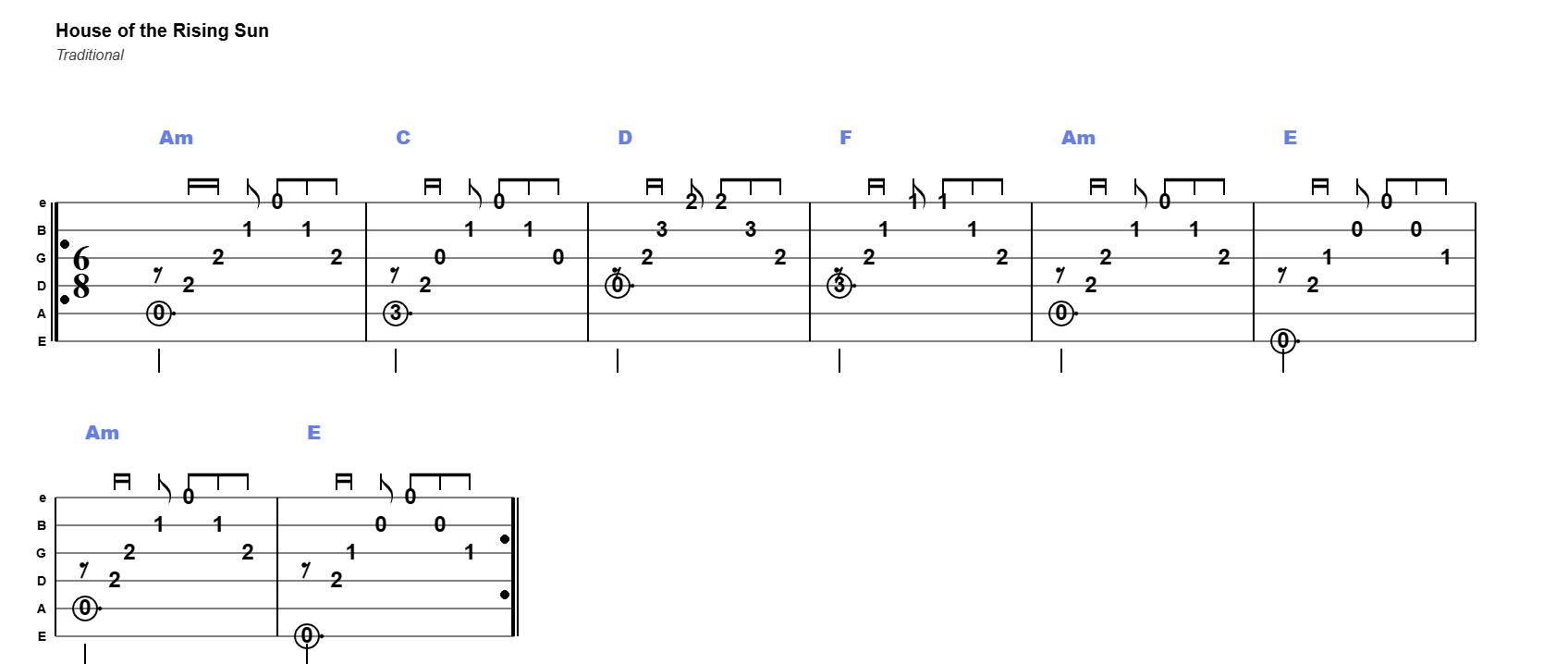
This arrangement of House of the Rising Sun uses a fingerpicking-style arpeggiated pattern across a series of open chords that fall naturally under the fingers. The song is in three-four time, so count "one-two-three, one-two-three" steadily as you play. Focus on letting each note ring clearly into the next — the beauty of this piece comes from the way the individual notes overlap to create a full, flowing sound. Take special care with the chord transitions, particularly moving between Am, C, D, and F, as keeping the arpeggio smooth through those changes is the real challenge. Start very slowly and resist the urge to speed up until every transition feels effortless. Once the pattern is comfortable, try adding slight dynamic emphasis on beat one of each measure to bring out the song's haunting, melancholic character.
This tab is rated beginner, which means it is designed for guitarists at the beginner level. If you are new to reading guitar tablature, check out our complete guide to reading guitar tabs before getting started.
When you click "Load in Tab Editor" above, the tab opens directly in Guitar Scribble's free editor where you have full control over the content. You can modify any notes, add your own variations, insert technique symbols like bends, slides, and hammer-ons, and adjust the arrangement to match your playing style.
Once you are happy with your version, a free account lets you save it to your personal tab library, export it as a PDF for printing, or share it as a PNG image. The editor is completely free and works in any modern web browser without downloads or installations.