Every note on the guitar neck in standard tuning. Switch between sharps and flats, show only the natural notes, highlight any note to see where it lives on every string, and print the chart as a free PDF.

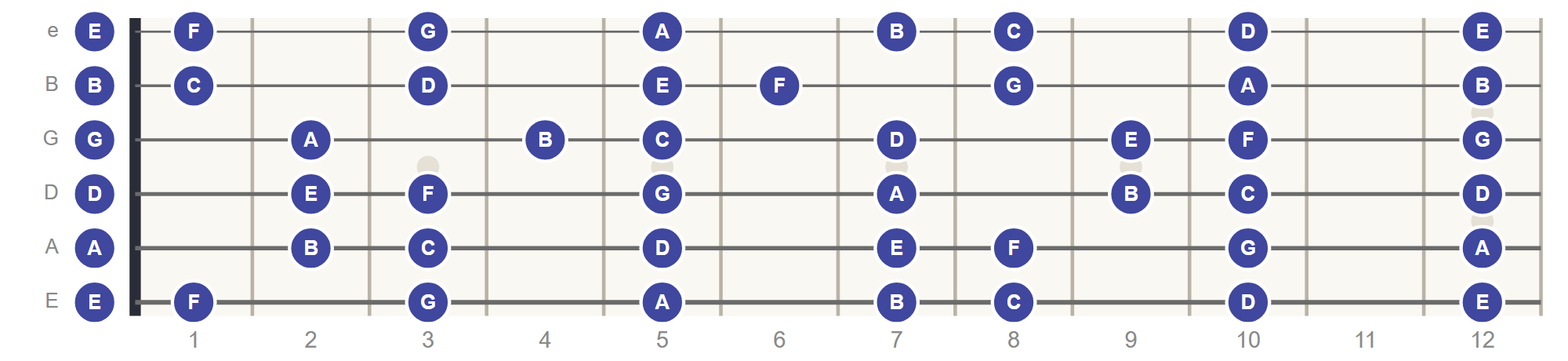
natural notes sharps and flats the note you highlighted. Nut at the left, thinnest string (high e) on top, fret numbers under the neck. The dots at frets 3, 5, 7, 9 and 12 are the inlays on a real guitar.
Download the chart as a PDF Tap frets and name the chord: Chord Finder
Open string to the 12th fret, thinnest string first. Natural notes are bold; a fret with two names shows the flat spelling underneath. The shaded frets, 3, 5, 7, 9 and 12, carry the inlay dots on most guitars.
| String | Open | 1 | 2 | 3 | 4 | 5 | 6 | 7 | 8 | 9 | 10 | 11 | 12 |
|---|---|---|---|---|---|---|---|---|---|---|---|---|---|
| e 1st (thinnest) | E | F | F#Gb | G | G#Ab | A | A#Bb | B | C | C#Db | D | D#Eb | E |
| B 2nd | B | C | C#Db | D | D#Eb | E | F | F#Gb | G | G#Ab | A | A#Bb | B |
| G 3rd | G | G#Ab | A | A#Bb | B | C | C#Db | D | D#Eb | E | F | F#Gb | G |
| D 4th | D | D#Eb | E | F | F#Gb | G | G#Ab | A | A#Bb | B | C | C#Db | D |
| A 5th | A | A#Bb | B | C | C#Db | D | D#Eb | E | F | F#Gb | G | G#Ab | A |
| E 6th (thickest) | E | F | F#Gb | G | G#Ab | A | A#Bb | B | C | C#Db | D | D#Eb | E |
Above the 12th fret everything repeats: fret 13 has the notes of fret 1, fret 15 the notes of fret 3, and so on up the neck.
The seven natural notes, C D E F G A B, are the frame everything else hangs on. They sit a whole step (two frets) apart except for two pairs that sit on neighboring frets: E to F and B to C. Spot those two half steps and the rest of the neck falls into place.
C# and Db are the same pitch. Which name you use depends on the key: in A major that note is C#, in Ab major it is Db. Chord charts and scales spell notes so each letter appears once, which is why the scales chart shows Bb in F major but A# in B major.
Every chord is a handful of these notes played together. Once you know the fretboard, a C chord is simply the notes C, E and G wherever you can reach them. The chord library shows the voicings, and the Diagram Maker names any shape you draw.
In standard tuning the open strings are E, A, D, G, B and E, from the thickest string to the thinnest. Each fret raises a string by one half step through the twelve notes (C, C#, D, D#, E, F, F#, G, G#, A, A#, B), so the 12th fret is the open string again, one octave higher, and the pattern repeats above it. The chart on this page shows every one of those notes.
Learn the natural notes on the two low strings first, using the fret markers at 3, 5, 7 and 12 as landmarks, then use octave shapes to find the same note on the other strings: from the E or A string an octave is two strings higher and two frets up, from the D or G string it is two strings higher and three frets up. Pick one note a day, find it everywhere on the neck, and check yourself with the highlight buttons on this chart.
They are the same pitch spelled two ways. The spelling depends on the key: a piece in A major calls that note C#, a piece in Ab major calls it Db. Guitarists usually read the sharp names going up the neck and the flat names coming down. Switch the chart between sharps and flats to see both.
From the thickest string to the thinnest: A, D, G, C, E and A. Four of them are the same notes as the next open string up, which is the old trick for tuning by ear. The exception is the G string, whose 4th fret matches the open B string.
Yes. The notes are the same; only the picture is mirrored. Read the chart with the nut on your right, or print the PDF and hold it up to a mirror if that helps. The string order from thickest to thinnest does not change.
Yes. The free PDF has every note in sharps and in flats, a natural-notes-only chart, and the notes on each string up to the 12th fret, laid out on two letter-size pages for a music stand or a practice folder.
Guitar scales chart (pentatonic, blues, major, minor and the modes on this same neck), the capo chart, the printable chord chart, blank tab paper and blank chord diagrams. All free, all printable.