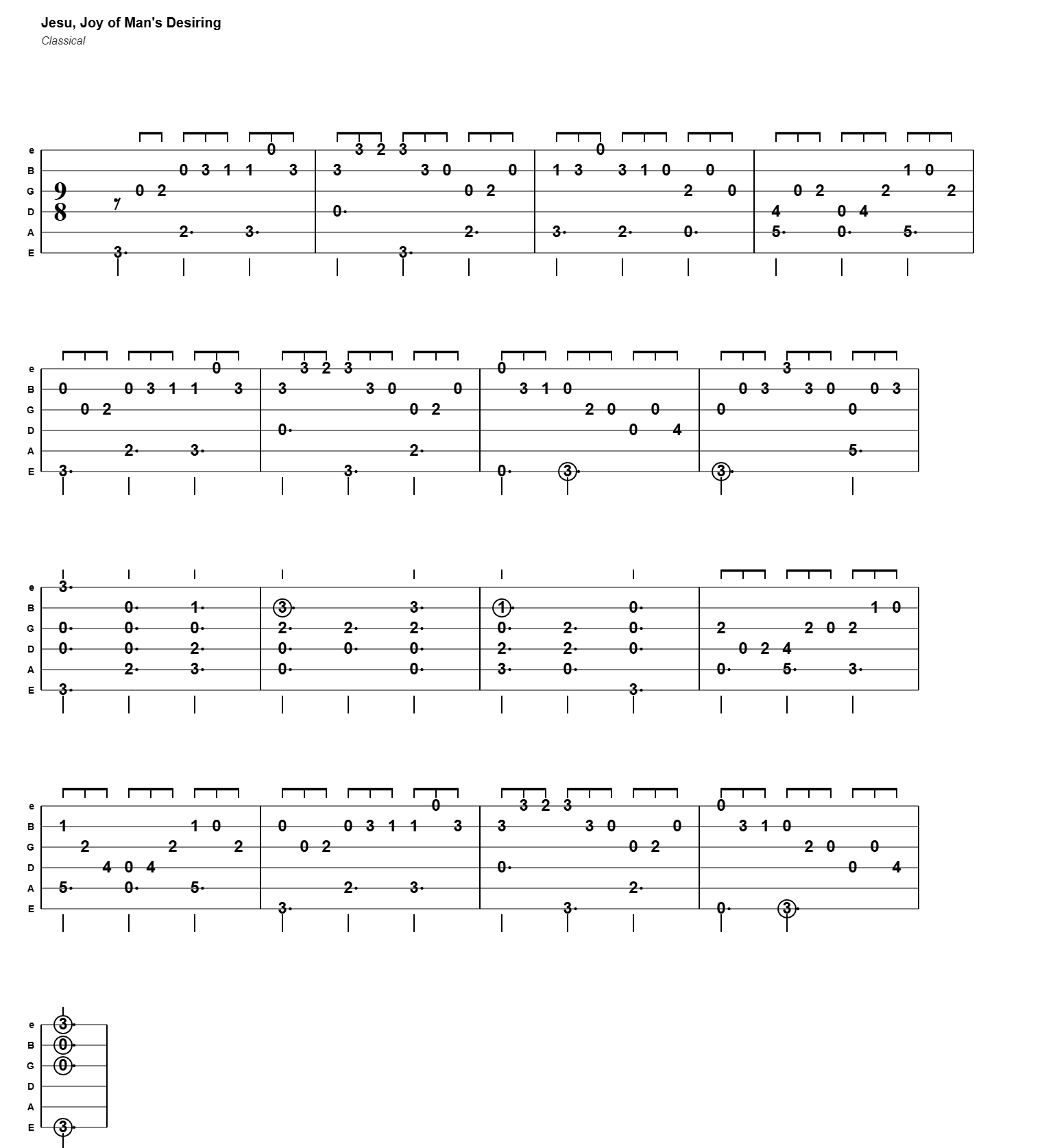
Jesu, Joy of Man's Desiring is the chorale that closes both halves of Johann Sebastian Bach's 1723 cantata Herz und Mund und Tat und Leben (BWV 147), where it is sung as "Jesus bleibet meine Freude." Bach did not invent the hymn tune itself: it began as a melody by the violinist Johann Schop in 1642, which Bach reharmonized and wrapped in the flowing instrumental line that the whole world now recognizes. That rippling figuration, originally for the cantata's violins and oboes, is the real magic of the piece: a stream of gentle triplets that never stops moving while the harmony changes slowly underneath. The piece became a household name two centuries later when the English pianist Myra Hess published her beloved piano transcription in 1926, and it has been a fixture of weddings and quiet Sunday playlists ever since. This arrangement returns to Bach's original and sets the famous instrumental line, together with the first singing phrase of the chorale itself, for solo guitar in G major, the work's home key, with the melody flowing on the top strings over a simple bass. It is written here in 9/8, which reads identically to Bach's 3/4 with triplets: three big beats per bar, each carrying three flowing eighth notes. Bach's music is long in the public domain, and this arrangement is free for you to learn, print, and make your own. One honest note on scope: this is a simplified partial arrangement, the famous instrumental line and the first chorale phrase rather than the complete work, kept in open position so it stays learnable. More advanced students should treat it as a starting point and look for a full concert transcription suited to their skill level.
Jesu, Joy of Man's Desiring — Intermediate · Classical
Tip: Click "Load in Tab Editor" above to open this tab in Guitar Scribble's free editor. From there you can practice, modify the tab, adjust the tempo with our built-in metronome, save it to your library, or export it as a PDF.
How to Practice This Tab
The challenge at this level is texture: the melody should sing legato on top while the bass notes ring underneath for their full value, two voices from one instrument. Let every melody note ring into the next wherever the fingering allows, and keep your thumb strokes soft but deep so the bass supports without thumping. Work on dynamic shape: each phrase gently rises toward its highest note and relaxes away from it, and the music should breathe at the ends of the four-bar phrases. Keep the tempo modest and steady; the piece is marches nowhere, it flows.
About Classical Tabs
This tab is rated intermediate, which means it is designed for guitarists at the intermediate level. You should be comfortable with basic chord shapes, simple riffs, and reading standard tablature notation before attempting this tab.
Practice routine: Set your metronome to half the intended tempo and play through the entire tab once. Then identify the hardest measure and loop just that section ten times before playing through the full tab again. Gradually increase the tempo over multiple practice sessions. Our free online metronome is built for exactly this kind of focused practice.
Loading and Editing This Tab
When you click "Load in Tab Editor" above, the tab opens directly in Guitar Scribble's free editor where you have full control over the content. You can modify any notes, add your own variations, insert technique symbols like bends, slides, and hammer-ons, and adjust the arrangement to match your playing style.
Once you are happy with your version, a free account lets you save it to your personal tab library, export it as a PDF for printing, or share it as a PNG image. The editor is completely free and works in any modern web browser without downloads or installations.