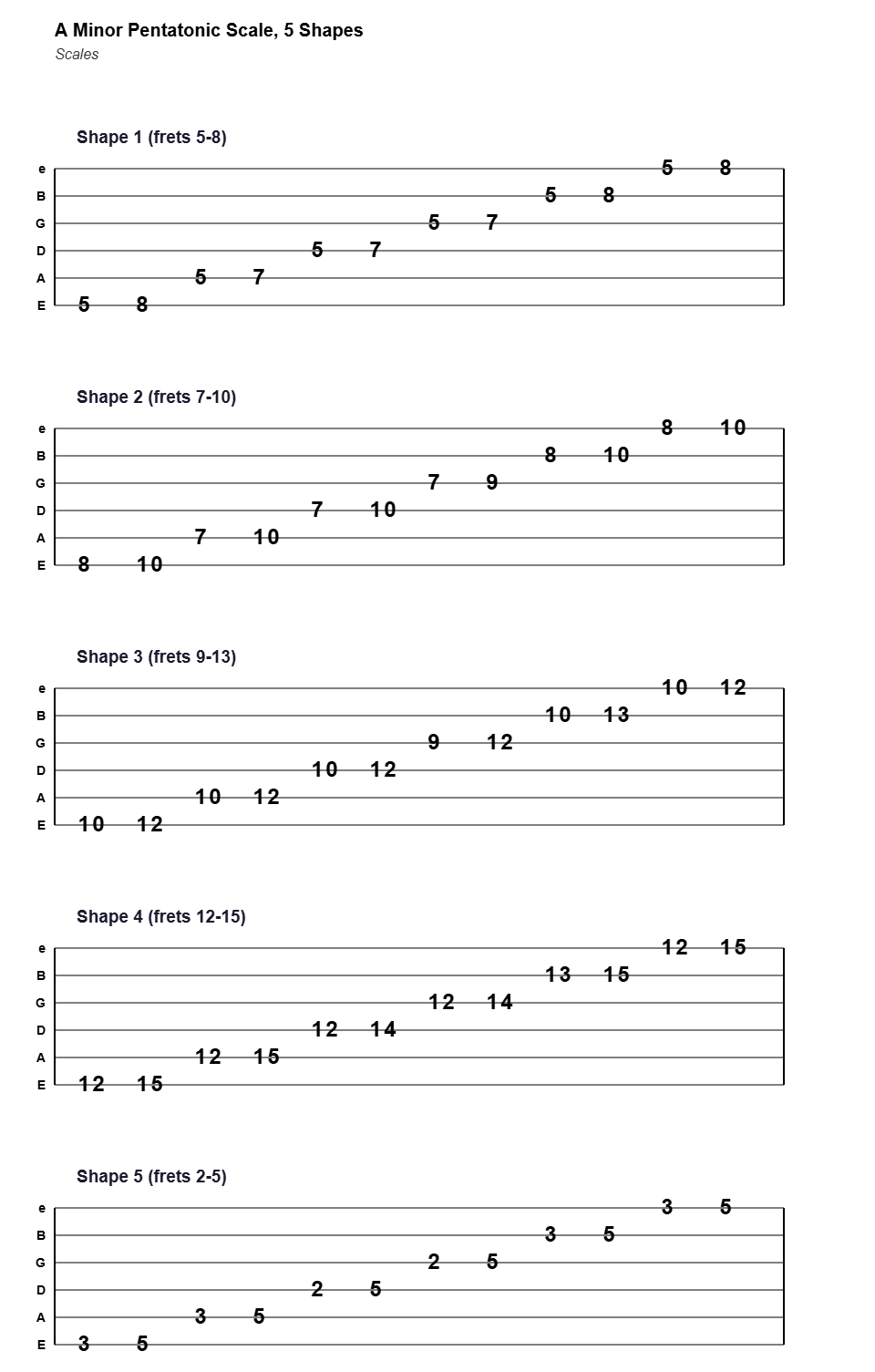
The A minor pentatonic is the most-played lead guitar scale in the world, and this tab gives you the complete picture: all five shapes, connecting every fret of the neck from the open position to the fifteenth fret. Its five notes (A, C, D, E, and G) power the majority of rock, blues, and metal solos ever recorded, and the famous fifth-fret box shown first here, Shape 1, is where nearly every guitarist learns to improvise. Here is the secret that doubles the value of everything on this page: these exact same shapes are also the C major pentatonic scale. A minor and C major are relative keys sharing identical notes, so when you play these boxes over an A minor or bluesy progression they sound dark and gritty, and over a C major progression the very same frets sound bright and sweet, the sound of countless country and pop solos. Learn the shape, get both scales free. Each line of the tab below is one shape, labeled with its fret range, and the five boxes interlock: the top of each shape shares its frets with the bottom of the next, which is how players run seamlessly from one end of the fretboard to the other.
Writing your own music? Start a blank tab from scratch, free →
👁 Preview printable PDF/PNGStart with Shape 1 at the fifth fret until it is automatic, ascending and descending with strict alternate picking, then add its neighbors Shape 2 and Shape 5 so you can spill out of the home box in either direction. Practice connecting adjacent shapes along a single string pair: play up Shape 1, shift up two frets on the G and B strings into Shape 2, and come back down. Then put on a backing track, A minor or a 12-bar blues in A for the moody sound, or a C major progression to hear the same frets turn sunny, and improvise inside one shape before roaming. As a daily workout, run each shape ascending at a slow metronome click and descending at the next click, top to bottom of the page: five shapes, the whole neck, every note of the scale under your fingers.
Scales are the foundation of melody, improvisation, and understanding the fretboard. Every solo, riff, and melodic line you hear in popular music is built from scale patterns. Learning scales is not just about memorizing shapes — it is about training your ears to hear intervals and your fingers to move efficiently across the neck. Every scale on this site is also drawn on the whole fretboard, in any key, on the guitar scales chart (free PDF included).
This tab is rated intermediate, which means it is designed for guitarists at the intermediate level. You should be comfortable with basic chord shapes, simple riffs, and reading standard tablature notation before attempting this tab.
When you click "Load in Tab Editor" above, the tab opens directly in Guitar Scribble's free editor where you have full control over the content. You can modify any notes, add your own variations, insert technique symbols like bends, slides, and hammer-ons, and adjust the arrangement to match your playing style.
Once you are happy with your version, a free account lets you save it to your personal tab library, export it as a PDF for printing, or share it as a PNG image. The editor is completely free and works in any modern web browser without downloads or installations.