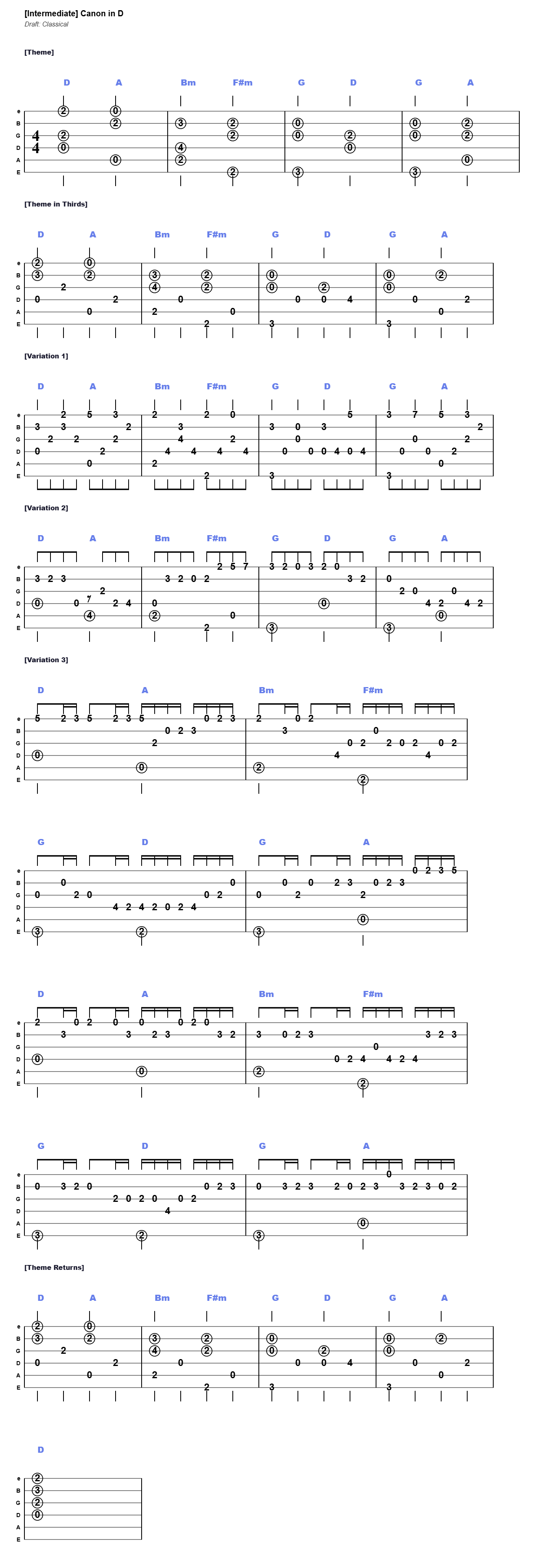
Canon in D is the most famous piece of music Johann Pachelbel ever wrote, and for long stretches of history it was nearly forgotten. Pachelbel, born in Nuremberg in 1653, was one of the most respected organists and teachers of his day, a friend of the Bach family who taught Johann Sebastian Bach's older brother. His Canon and Gigue for three violins and basso continuo was likely written around 1690, then sat in obscurity until the twentieth century, when recordings in the 1960s and 1970s turned it into one of the best known pieces of classical music in the world. Today it is a fixture at weddings and one of the most requested pieces a guitarist can learn. The canon is built on one of music's great engines: a ground bass of eight notes, D, A, B, F sharp, G, D, G, A, that repeats unchanged from the first bar to the last while the upper voices climb through variations of steadily increasing motion. That design makes it ideal for solo guitar, and this arrangement keeps the two layers honest: the bass line sits in a lower voice with its stems down, the melody rides above with its stems up, and the variations move from sustained chords through quarter notes and eighth notes to a sixteenth note climax before the theme returns to close. As a seventeenth century work, Canon in D is firmly in the public domain.
Tip: Click "Load in Tab Editor" above to open this tab in Guitar Scribble's free editor. From there you can practice, modify the tab, adjust the tempo with our built-in metronome, save it to your library, or export it as a PDF.
Tap any chord for its diagram, other voicings, and the notes inside it, from our chord library.
How to Practice This Tab
This arrangement follows the shape of the original: each four bar section is one pass through the ground bass, so once your left hand knows the bass pattern you can give your attention to the melody above it. Work on the sections in order, since they are graded. The opening chords should ring their full value with the melody note on top voiced a little louder than the notes under it. In the walking sections, keep the bass notes on the beat firm and let the off beat notes stay light. The sixteenth note variation is the summit of the piece: practice it in one bar slices, slowly, keeping your right hand pattern consistent, and only join the bars once each one flows. A steady, singing performance at a moderate tempo beats a rushed one every time, and the piece should feel calm even at its busiest.
Right-Hand Tips for This Arrangement
Learn the bass line first. The same eight bass notes repeat through the whole piece, two to a bar. Play the bass alone until the pattern is automatic, then add the melody on top. Your thumb plays every stem down note.
Let the open strings do the work. The key of D major puts three of the eight bass notes on open strings. Keep fretted bass notes held their full two beats while the melody moves above them.
Pace the build. Each section moves a little faster than the one before it. Resist speeding up: the tempo stays the same while the note values shrink, and that is where the piece gets its sense of gathering motion.
About Classical Tabs
This tab is rated intermediate, which means it is designed for guitarists at the intermediate level. You should be comfortable with basic chord shapes, simple riffs, and reading standard tablature notation before attempting this tab.
Practice routine: Set your metronome to half the intended tempo and play through the entire tab once. Then identify the hardest measure and loop just that section ten times before playing through the full tab again. Gradually increase the tempo over multiple practice sessions. Our free online metronome is built for exactly this kind of focused practice.
Loading and Editing This Tab
When you click "Load in Tab Editor" above, the tab opens directly in Guitar Scribble's free editor where you have full control over the content. You can modify any notes, add your own variations, insert technique symbols like bends, slides, and hammer-ons, and adjust the arrangement to match your playing style.
Once you are happy with your version, a free account lets you save it to your personal tab library, export it as a PDF for printing, or share it as a PNG image. The editor is completely free and works in any modern web browser without downloads or installations.