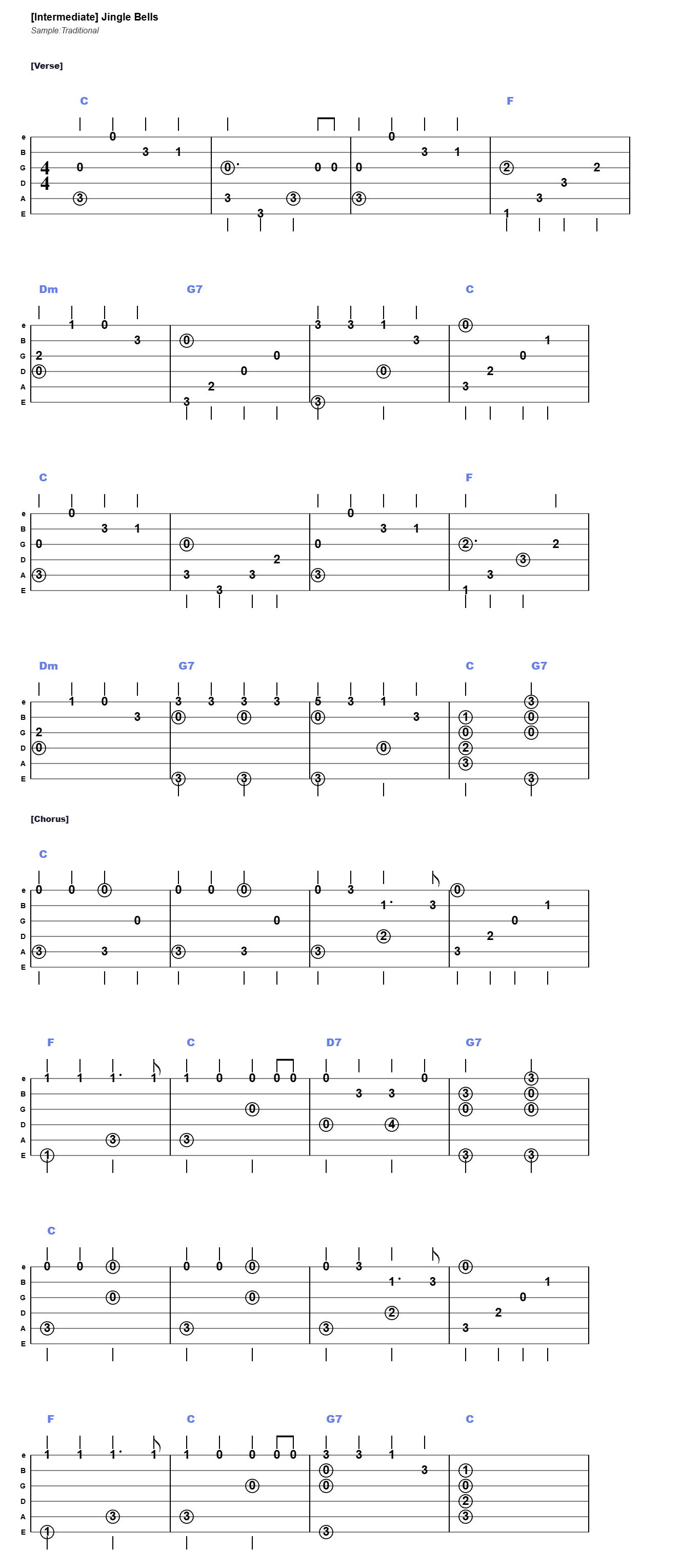
Jingle Bells was not written as a Christmas song. James Lord Pierpont published it in Boston in 1857 as "The One Horse Open Sleigh," a song about the winter sleigh races young men ran through the streets of Medford, Massachusetts, complete with a crash in a snowbank and a girl named Fanny Bright, and for decades it was sung at Thanksgiving as readily as at Christmas. It has collected some remarkable firsts since: it was among the earliest songs ever put on a record in the 1890s, and in December 1965 it became the first song performed in space, when the crew of Gemini 6 reported a strange object with eight smaller objects in front of it and then played Jingle Bells on a smuggled harmonica and a handful of sleigh bells. The tune is here in two versions, both in the key of C. The beginner tab is the complete melody, the verse ("Dashing through the snow") and the chorus everyone knows, in single notes on the top three strings in open position. The intermediate tab is a fingerstyle chord melody arrangement: the same tune on top with a fingerpicked bass line under it in a second voice, so one guitar carries the melody and the harmony at once. Chord names sit above the staff in both, and they match our Jingle Bells chords and lyrics sheet in C, so a second player can strum and sing along. The words and melody have been public domain for well over a century, so the song is free to learn, print, and perform. A note on scope: this is the melody as it is sung today; Pierpont's 1857 chorus had a different tune.
Tip: Click "Load in Tab Editor" above to open this tab in Guitar Scribble's free editor. From there you can practice, modify the tab, adjust the tempo with our built-in metronome, save it to your library, or export it as a PDF.
Prefer to strum and sing it? See the Jingle Bells chords and lyrics, written in the key of G and switchable to any other key, free to print.
Tap any chord for its diagram, other voicings, and the notes inside it, from our chord library.
How to Practice This Tab
This is a fingerstyle chord melody arrangement: the melody stays on the top strings and a fingerpicked bass line runs under it in a second voice, stems up for the tune, stems down for the bass, the classic solo guitar texture where one player covers both parts. The bass is mostly quarter notes on the beat, the root of each chord with fifths and short walk-ups between changes, and at the ends of phrases the low voice fills out into a strummed chord under the long melody note. Fingerpick it the standard way: thumb on the bass strings, index and middle fingers on the melody, and let every bass note ring into the next instead of cutting it short. When the low voice fills out into a chord, pluck the whole shape together with thumb and fingers rather than strumming it. Learn it in layers: the melody alone first (the beginner tab on this site is exactly that part), then the bass line alone, counting a steady "one-two-three-four" so each low note lands on its beat, and only then both together, one bar at a time. The chord names above the staff tell you what each bass note is doing, so if a change feels awkward, look at the name and find the root. Keep the tune on top: the melody should always be the louder voice, with the bass a quiet, even pulse under it. Once it flows, use the audio player to check your timing, then take it up to a brighter tempo, since the song wants to trot.
About Traditional Tabs
This tab is rated intermediate, which means it is designed for guitarists at the intermediate level. You should be comfortable with basic chord shapes, simple riffs, and reading standard tablature notation before attempting this tab.
Practice routine: Set your metronome to half the intended tempo and play through the entire tab once. Then identify the hardest measure and loop just that section ten times before playing through the full tab again. Gradually increase the tempo over multiple practice sessions. Our free online metronome is built for exactly this kind of focused practice.
Loading and Editing This Tab
When you click "Load in Tab Editor" above, the tab opens directly in Guitar Scribble's free editor where you have full control over the content. You can modify any notes, add your own variations, insert technique symbols like bends, slides, and hammer-ons, and adjust the arrangement to match your playing style.
Once you are happy with your version, a free account lets you save it to your personal tab library, export it as a PDF for printing, or share it as a PNG image. The editor is completely free and works in any modern web browser without downloads or installations.