Traditional American · Key of G · Public domain
This chart was made with the free Chord Sheet Maker: write your own charts, transpose in one click, print clean copies.
Opens in the Chord Sheet Maker in this key: change chords, add strumming patterns, and make it yours, with no account needed to start. A free account adds PDF downloads for printing.
Have your own songs? Start a blank chart from scratch, free →
This chart is written in G. Tap any key above the chart to see the whole song in that key, with every chord already worked out. To stay in G with different chord shapes, play it capo 3 with the E shapes, or capo 5 with the D shapes, or capo 7 with the C shapes. Singing with a group? Pick the key where the highest note is comfortable for everyone, then print that page.
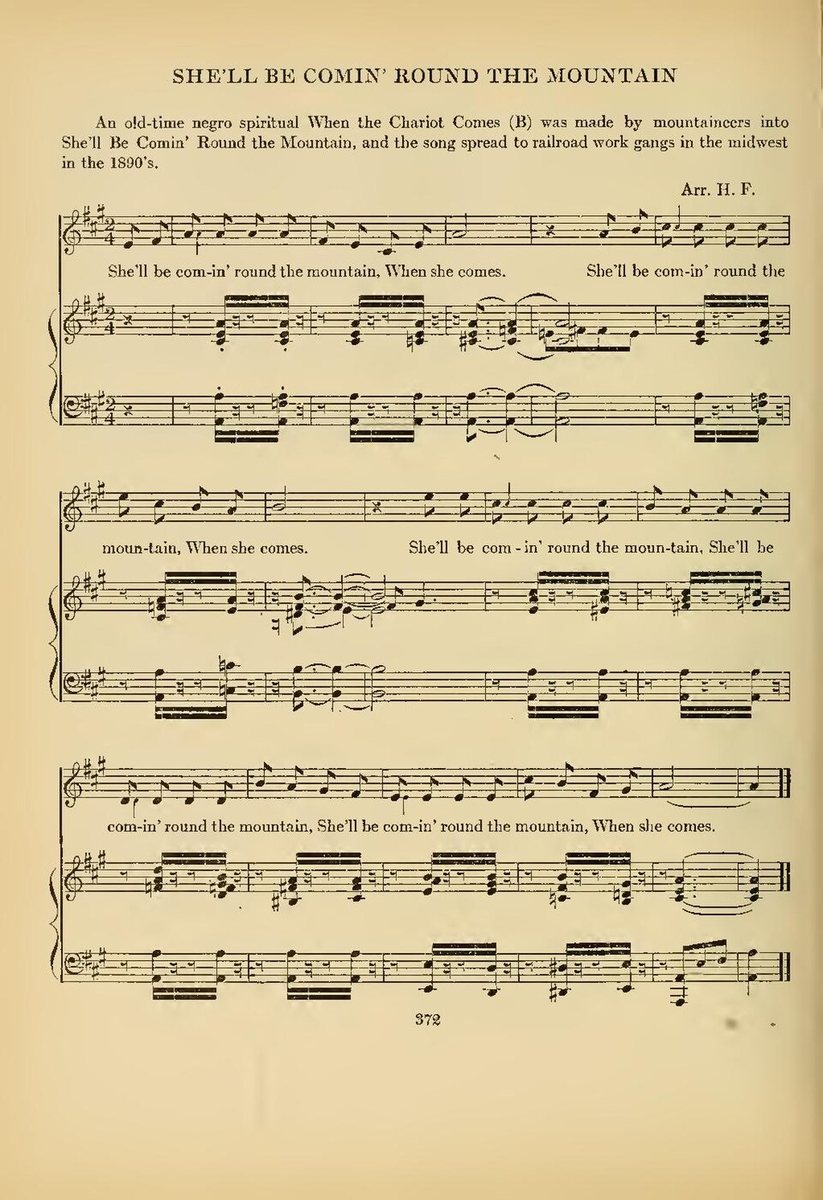
The tune began as a spiritual. "When the Chariot Comes" asks "O who will drive the chariot when she comes?" and answers "King Jesus, he'll be driver"; the "she" is the chariot of the Second Coming. William E. Barton printed it in 1899 in Old Plantation Hymns, remarking on how the word "comes" was stretched into five syllables. Somewhere in the Southern mountains the same melody picked up new words about a visitor coming round the mountain, and Carl Sandburg, who gave the song its first printing in The American Songbag in 1927, reported that railroad work gangs in the Midwest were singing it by the 1890s.
Sandburg printed three verses: she will come round the mountain, she will be driving six white horses, and we will all go to meet her, kill the old red rooster, and have chicken and dumplings when she comes. Henry Whitter made the first recording in 1924, and a 1916 college yearbook from North Carolina already shows students parodying it, so it was well known before anyone wrote it down. The red pajamas, Grandma's bed and the "toot, toot!" responses are not in any of the early printings, which is why they are not on this chart. The words and melody here are in the public domain.
Three chords in G: G, C and D7, in a brisk two. Every verse is the same five lines. Stay on G for the first line, hit D7 on the second "comes," go back to G for the third line and to C for the fourth, then G for the last line with D7 on "when she" and home to G on "comes." Strum down-down-up and keep it moving; this song dies if it drags. It is built for a crowd: let one person call each new verse and everyone answer, and if your group is in the habit of shouting responses after each line, leave a beat of space for them.
Tap any chord for its diagram, other voicings, and the notes inside it.
Another work-gang song: I've Been Working on the Railroad chords and lyrics
All the campfire and folk song chord sheets, each one in every key.
Further reading: She'll Be Coming 'Round the Mountain (Wikipedia)